
|
|

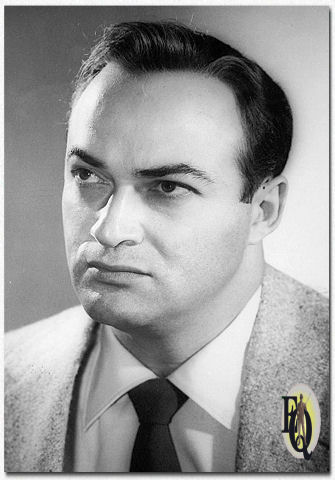

  awrence
Dobkin (September 16. 1919 - October 28. 2002) awrence
Dobkin (September 16. 1919 - October 28. 2002) |
|
Height: 5' 11" Weight: 185 lbs 35 oz Eyes: brown Marriages: (1) Frances Hope Walker, (Aug 29. 1942, divorced Jun 8. 1960) Child: 1 daughter Debra (Deborah Janke) (2) Joanna Barnes, actress (Jun 24. 1962, divorced Jan 16. 1967) (3) Anne Collings, actress (married Sep 23. 1972 - Oct 28. 2002, his death) Children: identical twin daughters named Kristy and Kaela (Mar 25. 1970) Kristy became a actress/writer and Kaela an actress/producer. Anne's son Laird Fenwick was Larry's stepson. Siblings: Harold (Jun 6. 1915 - Jan 27. 1970), Francine (Frances) L. Vilkin (1927) |
| Lawrence Dobkin was born on September 16. 1919 in New York City to immigrants Samuel Dobkin, a Russian (1905 from Yekaterinoslav, present Ukraine) tailor later restaurant owner and Austrian Frieda Feder (Freda, Fredia) (1906). |
|
His acting career began almost entirely by accident. Until he was nearly eleven years old, he had no interest in the theater and had never even attended a play. As he later recalled, "The first thing I ever knew about theater was when I got cast in a play. That was the first I ever heard of." While attending public school, he was cast as the Pirate King in a production of The Pirates of Penzance. After only two or three rehearsals, however, he became seriously ill with a heart condition. He was bedridden for six months, recovered briefly for three weeks, and then relapsed for another two months, causing him to miss the production entirely, although he still graduated. Because doctors feared the illness might prove fatal, they advised his parents never to deny him anything. Looking back, he remarked with amusement, "My parents must not deny me anything for fear that it would kill me... So, my word became law. I didn't even know my own power until later, much later" Although the illness prevented his stage debut, the few rehearsals had left a lasting impression. "I had enjoyed the three or four rehearsals," he remembered. "I liked the attention. I liked the whole idea of make-believe." Determined not to miss another opportunity, he joined the drama society at Townsend Harris High School. His first high school performance immediately revealed his natural comic instincts. Larry readily admitted that the theatrical bug hit hem when he appeared in George Kelly's The Show Off with his high school dramatic society. Appearing in a series of French farces, he entered the stage alone before the other actors. Faced with a silent audience and unsure how to begin, he instinctively invented a bit of business by pretending to remove an imaginary stain from a cloth-covered table. When the imaginary stain refused to disappear, he looked around to make sure no one was watching, spat on the spot, and rubbed it again. The audience erupted with laughter. "There was a huge roar from the theater," he recalled. "From that moment on I was, as they say in the trade, a star in my own heart. I got my first laugh." Reflecting on that moment, he simply added, "I found myself in show business." (8) While still in high school he did his first acting playing an evil little boy on the Ted Cott's WOR series The Ebony Elephant (WNYC). Academically, he progressed with remarkable speed. He graduated from high school at the age of fifteen and entered the City College of New York (CCNY) before turning sixteen. He explained that rapid promotion through the grades was common at the time, joking, "Those were the years... if a kid could blow his nose unaided, they promoted him. They were forever skipping grades." (8) While still a college student, he made his Broadway debut during a summer production of George Sklar's anti-Nazi drama Blood on the Moon. Originally cast in a small role, he unexpectedly inherited the leading part when Alexander Scourby left the production. The experience convinced him that natural talent alone was not enough. "I already knew that I had to learn. I had to study. I had to go someplace and find out why it worked." Seeking professional training, he asked the production's director for advice and was told, "Go to my school. It's the only—the best school I know of... Yale University. It's the Graduate School of Drama." That recommendation would lead him to formal dramatic training at Yale and mark the beginning of his professional education as an actor. (8) Dobkin had been bald since he was 18 years old. He had "five heads", the bold one plus four others depending on which of four hair pieces he used. |
|
Following the advice of the play's director, he applied to the Yale School of Drama. Admission did not come easily. His application was rejected three years in succession, and after the third refusal he decided to give up. It was his father who persuaded him to make one final effort by traveling to New Haven and asking the school directly why he had been turned down. There he met with Yale registrar Mabel Hastings. She explained that his repeated rejections had nothing to do with his talent but with his age. The Yale School of Drama was a graduate program whose students were normally at least twenty-five years old, while he was still only seventeen, turning eighteen that September. After hearing about his unusual amount of professional stage experience, she invited him to provide letters documenting his work and promised to present his case to the faculty once more. The faculty agreed to admit him on a ninety-day probationary basis to determine whether he could keep up with the older and more experienced students. He quickly proved himself, and after only sixty days the probation was lifted. Financial problems, however, remained a constant concern. Having arrived after scholarships and campus jobs had already been assigned, he had to find other ways to finance his education. (8) So a much too young Dobkin went to Yale Drama School where he roomed with another future director, Richard Fleischer. There he attended the famous Baker 47 Workshop at Yale University, and first attracted profession interest with the revival of Maltz and Sklar's Merry-Go-Round. At Yale he was also seen in New Haven in the plays Keepers of the House (1939-40) and The King of Nowhere (1941-42). He distinguished himself as the youngest actor ever to play the title role in an uncut version of Hamlet and in his final academic year he broke another precedent by receiving his Master's thesis credit for his production of Letters to Lucerne. |
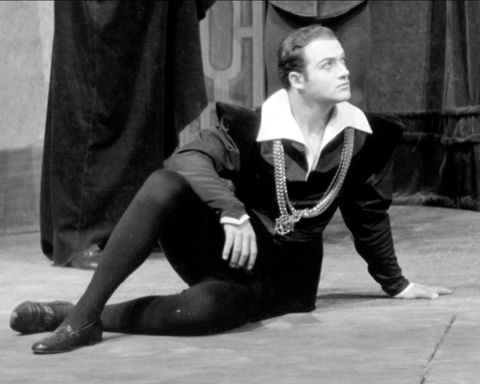 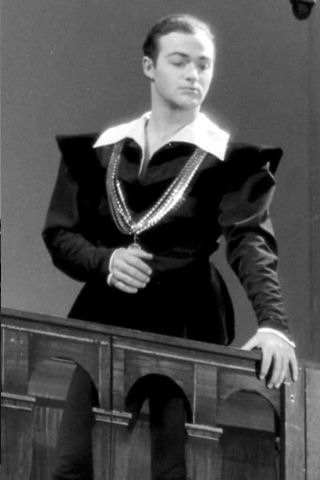 Above left and right: Larry distinguished himself as the youngest actor ever to play the title role in an uncut version of Hamlet (Hamlet, 1941-1942. Yale School of Drama Photographs and Posters, RU 397. Manuscripts and Archives, Yale University Library). |
| Upon graduating from Yale, he was immediately invited back to participate in the school's first summer session as an actor because there were no experienced performers available. He starred in Charlie Rave's fantasy Smith of Stratford (Yale University Theatre, New Haven, Aug 12-14. 1942), in which Larry played William Shakespeare who returns to life for forty-eight hours after the famous curse on his grave has been violated. The production gave him another opportunity to demonstrate the skills he had acquired during his years at Yale. "They hired me to rehearse and perform the play. I was already quite prominent, having been signed by Above agent Jane Broder before attending Yale, thanks to my work at Six and Company and 'Blood on the Moon' " (8) |
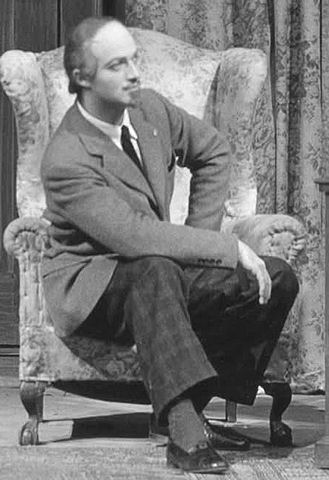 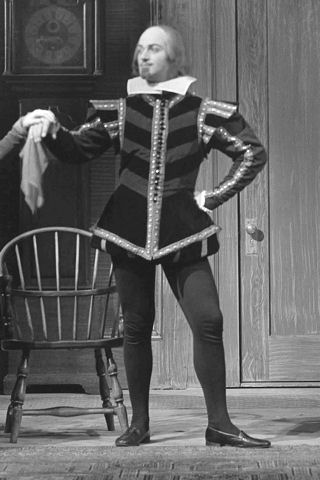 Above left and right: Larry played Shakespeare in Smith of Stratford (Yale University Theatre, New Haven, Aug 12-14. 1942) "Lawrence Dobkin, in the role of the bard, convinces that there is a place in the theatre for this lad" (Variety, Aug 19. 1942) (Smith of Stratford, 1942. Yale School of Drama Photographs and Posters, RU 397. Manuscripts and Archives, Yale University Library) |
|
Even before entering the drama school, his performance in Blood on the Moon had attracted enough attention to earn him representation by leading New York theatrical agent Jane Broder. Now he told Jane he needed to earn money. She offered two options: a small part as Paul Lucas’ understudy in a new Philip Barry play or reading for the road company of Lillian Hellman’s Watch on the Rhine in 1941-42**. He read the Philip Barry play and said, "I don't give it twenty minutes." She thought I was being cocky, but I insisted, "I know how to read a play, Jane." Liberty Jones quickly closed. He went on the road with Watch on the Rhine and earned money for seven months - more money working with the crew than he did as an actor. His Yale training proved valuable in unexpected ways. Touring productions frequently hired local stagehands who lacked experience assembling traveling theatrical sets. Drawing on the technical stagecraft he had learned at Yale, he volunteered to help rig scenery, hang lighting battens, and strike the set after performances. His abilities impressed the company's head carpenter so much that he obtained a temporary IATSE union card, enabling him to work both as an Equity actor and as a stagehand. For several months on the one-night tour, he earned more money helping build and dismantle the production than he did from acting on stage. This allowed him to begin repaying the debts he had accumulated during his years at Yale. (8) |
|
In New York and New Haven he began working in radio to pay for his studies. Before World War II, he appeared on regional series on the Yankee Network and New York-based series such as Superman.
Lawrence Dobkin found himself involved in many radio shows. He turned out to be one of the considerably-more-than-competent stable of leading and supporting radio actors in OTR whom directors knew they could call on without a qualm for a variety of roles. Of course he had to be featured in a soap opera. Every radio actor worth his salt was in at least one. Dobkin was a supporting cast member of the Granddaddy and possibly the most beloved of all soaps One Man's Family (NBC-Radio, 1932-59) which was a proving ground and stepping stone for many a fledgling actor and actress on the way to stardom. Hundreds passed through the "Barbour Family's" lives... and there was always room for more.
On August 29. 1942 he married Frances Hope Walker, the couple had one daughter Debra. |
|
|
|
While awaiting discharge from the Military in 1946, he acted on several civilian radio series that originated from New York including The Carrington Playhouse (Mutual, Feb 5. - Sep 26. 1946) produced and directed by fellow Air Force man Perry Lafferty.
Dobkin began a prolific career in television in 1946, having worked as an actor, narrator and director. He first played in a TV-movie Laughter in Paris (WNBT New York, Feb 17. 1946) and had a small role in the educational TV-series Your World (WNBT New York-NBC, Jun 10. 1946).
In Bridgehampton Lawrence directed Philadelphia Story (Hampton Playhouse, Jul 2. 1946).
A busy year because he also made his first appearance (without a screen credits) in the film The Best Years of Our Lives (RKO Radio Pictures, Nov 21. 1946) where played a small role as customer with a hat in the bank. |
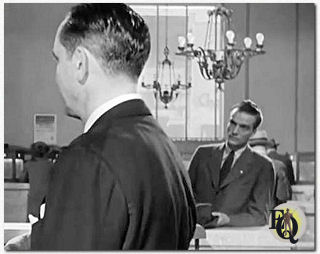 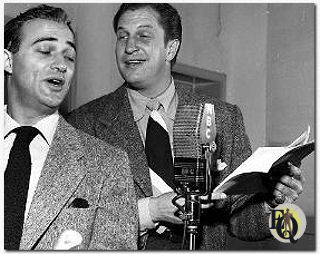 Above left: Detail from the film The Best Years of Our Lives (RKO Radio Pictures, Nov 21. 1946) in which Dobkin played a customer wearing a hat in the bank. Above right: Dobkin and Vincent Price during the radio broadcast of The Saint. |
| In 1947 he started in The Saint (CBS West Coast, Jul 9. 1947 - Jun 30. 1948 and CBS, Nov 6. 1949 - May 20. 1951, min 23 x) the doings of super-sleuth Simon Templar. Vincent Price then was the perfect Simon, they gave him an unending supply of wonderful one-liners. To provide his character with someone with whom he could trade one-liners, he was given a semi-regular sidekick Louie the cabdriver played by Larry. Dobkin had a New Yorker common man demeanor that played off quite nicely against Simon's upper class sensibility. There were five radio "Saints"... with Barry Sullivan and Vincent Price (until May 20. 1951) probably being the best-known. While playing Louie (1947-52), he was once asked to step into the lead role of Simon Templar to replace Tom Conway for a single episode — making Dobkin one of the few actors to portray Leslie Charteris' literary creation. |
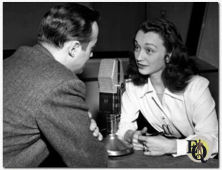 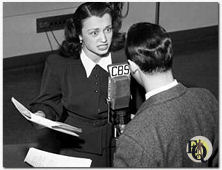 Above: "Incognito" Larry Dobkin as Ellery Queen playing opposite Charlotte Keane (Nikki Porter) in front of the CBS microphone (1947). |
|
Larry Dobkin took the challenge to play
lead in The Adventures of Ellery Queen (ABC, Nov 27. 1947).
The radioshow had
the unwritten law that if the guest star guessed the murderer you had to vamp a
different solution to the crime. Because only Ellery could solve the crime. "That only happened one time. Phil Harris was the guest star with Alice Faye on that episode*. And about twenty-five minutes into the broadcast, came to a complete stop, and, then Ellery, as an announcer, but still in the Ellery character, said to the audience in the studio, to the guest and to the radio audience, 'You now know everything that Ellery knows. So, you should be able to arrive at the solution before we play it out. Who do you think is the guilty party?' Well, in the whole eighteen months that I did Ellery Queen, Phil Harris was the only one who guessed it. It was the first words out of his mouth and my job then was to talk him out of it, to make him reconsider. So quite calmly, I pointed out the evidence that worked in the other direction and he began to have doubts. When his doubts were fully voiced, I said we're out of time, we have to go back in now. So, we played out the rest of the show and with the final music sting, Phil Harris was out for blood. He came across that studio and he was ready to punch my head because I talked him out of his intellectual triumph." (8)
When Dobkin was replaced by Howard Culver in January 1948 Dobkin said "When I was replaced as the voice of Ellery Queen, nobody gave me any notice. They just told me not to come back next week. They never told me why. I had done it for two years. ..."
"Television was on the verge of taking
over. We were quoting Fred Allen's line about TV, 'If you don't look at it,
it'll go away.' And we were still doing a 'live repeat' some three hours later
for the East Coast. The network was avoiding recording the show for reasons of
their own. That is, they were avoiding 'playing' the recording. I learned that
when I slept through the repeat time and phoned the station in a panic, only to
be told that they 'played the recording.' " (9) Playing Ellery Queen on both Coasts helped him gain access to acting jobs on Hollywood-based radio series. |
|
He was a part of the dramatic adventure anthology Escape (CBS, Jul 11. 1948 - Jun 29. 1954, min 32. x) and also of Suspense (CBS, Jul 15. 1948 - Aug 23. 1959, min. 36 x). ***
Dobkin was "Lt. Matthews" in another crime drama. The Adventures of Philip Marlowe (CBS, Oct 3. 1948 - Aug 18. 1951, min. 28 x). The title role was played by that fine radio actor Gerald Mohr, who took over from Van Heflin.
In 1948 NBC-Radio tried something that had never been done before. It offered its listeners a dramatic anthology which included great works of fiction that would allow for the receipt of college credits. It was called The NBC University Theater and stayed on the air until February of 1951. Dobkin was part (NBC, Oct 10. 1948 - Dec 9. 1950, min. 18 x) of the cast that included the best actors that both films and radio could offer with movie stars like Angela Lansbury, Herbert Marshall and David Niven, among others along with radio stars Lou Merrill, Paul Frees, John Dehner and many more.
In a switch, Dobkin was the announcer/actor for the adventure series Rocky Jordan (CBS-Radio, 1948-50) which told the story of a young American who owned a cafe in Cairo, Egypt and wanted nothing more than to run his little establishment in peace and quiet but gets so involved in other people's affairs that he turns detective Jack Moyles starred.
Dobkin was also a cast member of The Green Lama (CBS-Radio, Jun 5. - Aug 20. 1949) another very short-lived adventure series with Paul Frees starring as an American who spends ten years in Tibet developing special powers then returns home to use his gifts to fight crime.
In the detective series Yours Truly, Johnny Dollar (CBS, Aug 7. 1949 - Nov 13. 1960, min. 125 x) Dobkin was heard in the role of "Pat McCracken" the man who gives Johnny his assignments. |
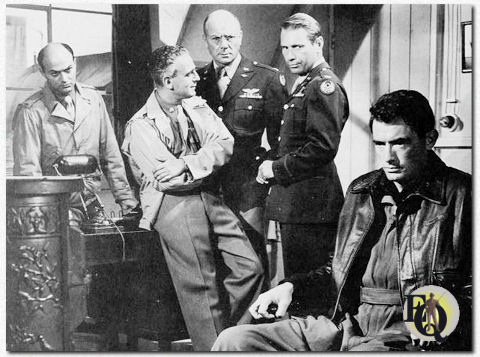 Above: One of the rare scenes from Twelve O’Clock High (20th Century Fox, Dec 21. 1949) with Larry in it. A battle-fatigued Gregory Peck (R) with looking on (L-R) Lawrence Dobkin, Paul Stewart, Dean Jagger and Gary Merrill. |
|
His involvement with Twelve O’Clock High (20th Century Fox, Dec 21. 1949), came through a screen test rather than a role that had originally been written for him. Dobkin was tested for the part eventually played by Dean Jagger, who portrayed Major General Harvey Stovall. Although Dobkin impressed the studio with his performance, Fox ultimately decided to cast Jagger in the role. However, because they liked Dobkin’s work, they offered him another important part: the chaplain, a strong supporting character. During production director Henry King significantly reduced the part while the film was being edited. By the time Dobkin arrived in Florida for filming, the assistant director informed him that there was hardly anything left to learn because most of the chaplain’s scenes had been removed. King eventually cut the character out of the final film entirely. Although he did not appear on screen, Dobkin still benefited from the experience. He joked that he had been the highest-paid actor on the picture "per word", because he had been paid for a role that ultimately contained no dialogue. (8) |
|
Dobkin was in several episodes of Romance (CBS, Aug 1. 1950 - Sep 18. 1954, min. 12 x) a charming anthology with a romantic bent that was beautifully written, directed and acted but never seemed to be able to find its proper niche on the air. As a result it was heard sporadically sometimes off the air for weeks or months at a time and could never build up the firm listening audience it so well deserved.
Dobkin was "Dave the sergeant" in yet another "shortie"... the police drama The Man From Homicide (ABC-NBC, Sep 16. 1950 - Sep 17. 1951, min. 8 x) with Dan Duryea as policeman "Lou Dana".
As of his third appearance in the series Larry Dobkin starred as one of six "Archies" the great detective's right-hand-man in The New Adventures of Nero Wolfe (NBC-Radio, Oct 20. 1950 - Dec 22. 1950, min. 8 x) in which the wonderful Sydney Greenstreet growls his way victoriously through the solving of the crime and still manages to stay at home and dine on gourmet meals. |
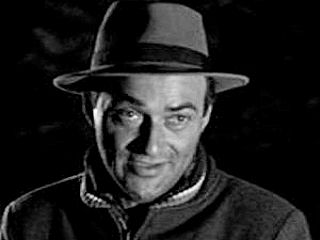
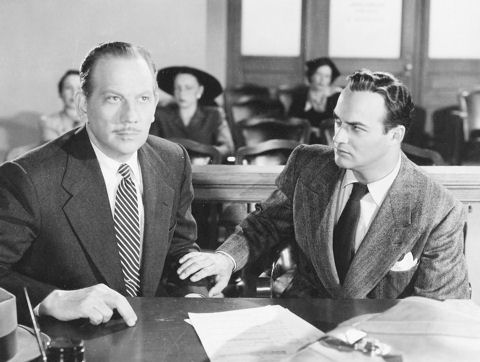 Above left: Larry Dobkin starred as one of four "Archies" the great detective's right-hand-man in The New Adventures of Nero Wolfe (NBC-Radio, 1950-51) in which the wonderful Sydney Greenstreet growls his way victoriously through the solving of the crime and still manages to stay at home and dine on gourmet meals. Above right: Melvyn Douglas and Lawrence Dobkin in On The Loose (RKO Radio Pictures, Sep 28. 1951). 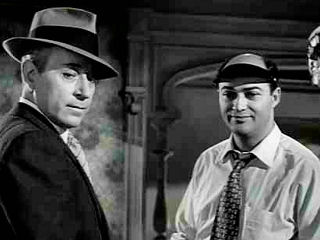 Above: George Raft and Larry Dobkin in Loan Shark (Lippert Pictures, May 23. 1952). |
| Dobkin was also part of Nightbeat (NBC-Radio, 1950 - 1952) which starred Frank Lovejoy in a crime drama that leaned heavily on human interest namely being about a reporter who cared about people who were down and out through no fault of their own, so he tried to help them as best he could. It was a superb series with an equally superb supporting cast consisting of the best names in the radio acting business such as Ted de Corsia (Velie!), Lurene Tuttle, Howard McNear and Lovejoy's own real-life wife Joan Banks among the ones contributing their talents to the show. |
|
He is remembered for his (uncredited) role of the kindly and soft-spoken Rabbi in the original and touching Angels in the Outfield (MGM, Sep 7. 1951), in that same film Bing Crosby had an uncredited cameo as did baseball greats Ty Cobb and Joe DiMaggio. Since he did not have typical movie star "looks" (being quite bald and not overly muscle-bound) in films he was mostly cast as a villain. Though in the now-classic sci-fi thriller The Day the Earth Stood Still (20th Century-Fox, Sep 18. 1951) he played a psychiatrist trying to figure out the whys and wherefores of an alien visitor from outer space called "Klaatu". Then there was the short-lived crime drama The Judge (CBS-Radio, Jun 5. 1952) played by John Dehner in which Dobkin was featured as the police lieutenant.
Larry Dobkin made quite a few appearances on Gunsmoke (CBS, Jun 7. 1952 - Mar 12. 1961, min. 204 x) the well-loved Western forerunner to the television series of the same name. Rogers of the Gazette (CBS, Jul 3. 1953 - Dec 30. 1953, min. 4x) of which Dobkin was a cast member starred Will Rogers, Jr. as "Will Rogers", editor of a small-town Georgia newspaper. Though the radio series was never actually accused of having based his character on Rogers' late, brilliant stage star/screen star/comic/philosopher/cowboy/roper/author/columnist who "never met a man he didn't like" father there was a marked resemblance between the two. He had a supporting role in Julius Caesar (MGM, Jun 3. 1953) and appeared in Cecil B. De Mille's epic The Ten Commandments (Paramount, Oct 5. 1956) that starred Charlton Heston as Moses. Dobkin appeared in several I Love Lucy shows (CBS, Jun 22. 1953 - Feb 27. 1956, min. 3). |
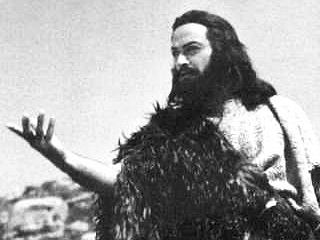
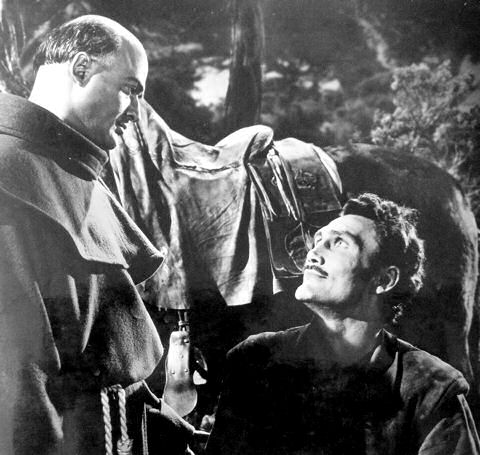 Above left: As Ephraim in The Silver Chalice (Warner Bros. Dec 17. 1954). Dobkin suffered several unexpected blows during a rehearsal scene in which actor John Reisman’s character, a captain of the guard, summoned him to the door. Reisman nearly broke his arm with one strike, Dobkin warned him to pull his punches, but Reisman insisted he had to act instinctively. Dobkin obtained a piece of angle iron, covered it with foam rubber, and taped it under his robe, ending the scene and teaching the overly committed actor a painful lesson. (8) Above right: Kiss of Fire (Universal, Nov 1. 1955) with Lawrence Dobkin and Jack Palance. 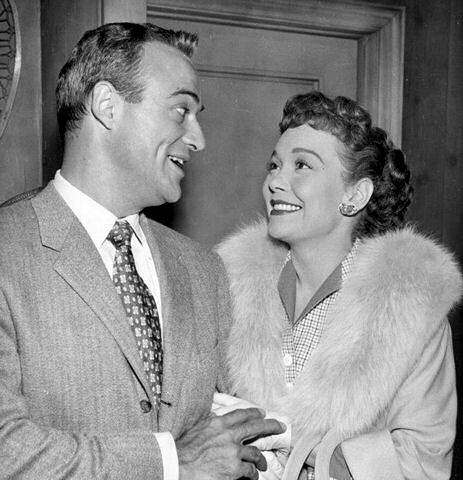
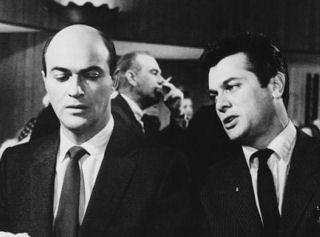 Above left: Between 1956 en 1957 Dobkin guested four times in the TV-series Jane Wyman Presents the Fireside Theatre (aka The Jane Wyman Show). In the episode "The Past Is Always Present" (NBC, Apr 17. 1956) Larry and Jane Wyman are honeymooners, when Jane learns by chance that her husband had been tried for the murder of his first wife. Above right: In The Sweet Smell of Success (United Artists, Jun 27. 1957) opposite Tony Curtis. |
|
Reportedly, Dobkin mastered no fewer than 25 different dialects. This talent kept him working almost constantly. Among the types he portrayed are "general European" (so labeled so that no one will be offended), Mexicans, Italians, Frenchmen, Germans, Russians, Indians, and Jews. In the 1957 - 1958 television season, he played a director on the CBS sitcom, Mr. Adams and Eve, starring Howard Duff and Ida Lupino as fictitious married actors residing in Beverly Hills, California. He appeared in an episode of the early syndicated series The Silent Service, based on true stories of the submarine section of the United States Navy. In the episode "The Ordeal of the S 38" (Syndicated, Jul 12. 1958) he played the lead wrongly credited as Lawrence Bobdkin (sic). Dobkin played in the vastly under-rated Frontier Gentleman (CBS, Feb 2. - Nov 16. 1958, min. 18 x), an Englishman's account of life and death in "... the early days of... the American West. " John Dehner starred in a well-written and - acted series that, unfortunately, went on the air during the declining days of radio and the ascension of television. Art imitates life when in "The End of the World" (Trackdown, CBS, May 9. 1958), Lawrence Dobkin played con man Walter Trump (!), who convinces a Texas town that deadly meteors will strike at midnight. Claiming only he can save them, he sells "magical" metal walls for $50 each. Ranger Gilman sees through the scam and ultimately arrests Trump for fraud and grand theft. He was real-life murderer "Dutch" Schultz on TV's The Untouchables (ABC, Nov 19. 1959 - Oct 20. 1960, min.3). |
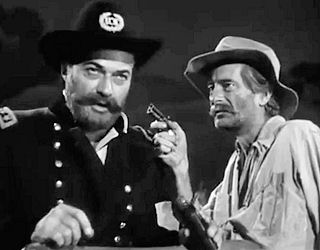
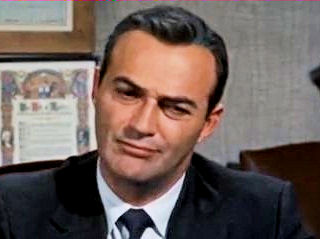 Above left: Dobkin as General Philip Sheridan in The Rifleman ("The Sheridan Story", ABC, Jan 13. 1959). He played the same character again in Cheyenne (ABC, Jan 11. 1960). Above right: As US Intelligence Agency Official (uncredited) in Hitchcock's North by Northwest (MGM, Jul 1. 1959), Dobkin discusses the plight of the hero, who has been mistaken for an agent who doesn't exist and has now become a murder suspect. "It's so horribly sad," he says drily, "why is it I feel like laughing?" 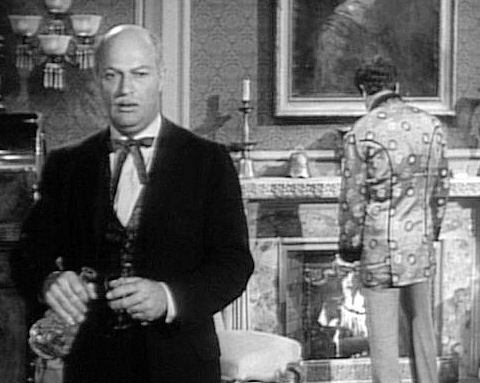
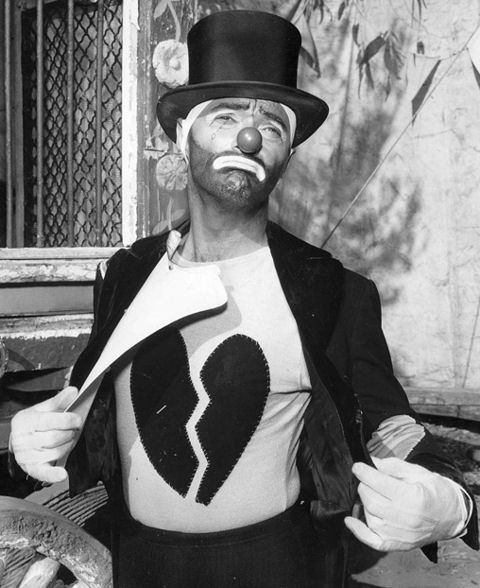 Above left: In "Love of a Bad Woman" (Have Gun - Will Travel, CBS, Mar 26. 1960) Dobkin (Haskel) believes his wife has hidden murderous intent. Above right: Lawrence Dobkin portrays an unsuspecting heavy in the "Prairie Elephant" episode of Rawhide (CBS, Nov. 17. 1961) |
|
In 1960, he appeared as Kurt Reynolds in "So Dim the Light" of the CBS anthology series, The DuPont Show with June Allyson. After nearly 18 years Dobkin's first marriage to Frances ended in a divorce on June 8. 1960. On June 24. 1961 he married Joanna Barnes. They had met on the set of the Richard Diamond, Private Detective television show for CBS. This was certainly his most publicized marriage. Actress Joanna Barnes was very outspoken, and in a 1963 newspaper, it was reported that Miss Barnes and her husband chose their friends from among Hollywood's more sophisticated personalities as opposed to the glamour seekers. "We stay away from people who are narrow and dull, whether they are actors, plumbers, or doctors," Joanna said. The couple also had a Boston house built in 1634, which went back to Barney Oldfield. It was vaguely English, had magnificent hand-carved pillars, and some antique bathrooms that had to be ripped out, including the pipes. Luckily, Dobkin had learned to design and build sets and lighting at Yale Drama School. This was great when it came to repairs around the house. However, he did get a charley horse while painting the dining room ceiling. (1965) |
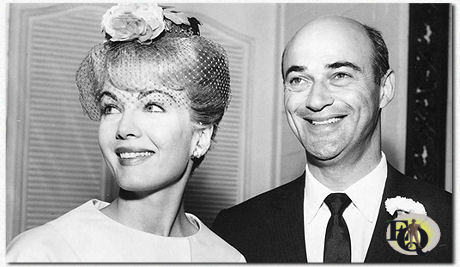 Above: "Joanna Barnes and Larry Dobkin were married today at 4:30 at the Ambassador Hotel. Dr. Donald Curtis of Science of Mind Church officiated. Best man was William Conrad. matron of honor was Mrs. Richard Batchellor." (Jun 24. 1961). |
|
In the 1960's Dobkin turned his attention to writing and directing with an occasional movie thrown in. So when Dobkin seemed to vanish from the big and small screen in the mid-60’s it was a shift behind the camera to a very successful career as a TV director. "I find myself being very patient when I direct. I find that I am able to slide a curative knife in without hurting." He once stated that he made the switch to director (1964) because "my brain was turning to oatmeal." So for three years he didn't act except for an appearance in The Felony Squad (ABC, Apr 10. 1967) episode he was directing. He was lured back by a good role on CBS Playhouse in the episode "Do Not Go Gentle into the Good Night" (CBS, Oct. 17. 1967). For this supporting role he got an Emmy nomination. In June 1966 he directed a few episodes of the TV series Seaway for CBC and met actress Anne Collings. Dobkin's second marriage to Joanna Barnes did not last the couple separated on July 4. 1966 and were divorced on January 16. 1967. |
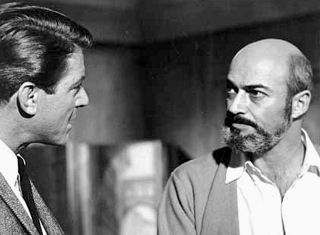
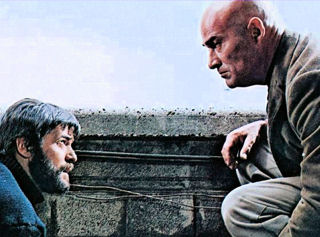 Above left: Lawrence Dobkin (R), shown with Efrem Zimabalist Jr. in a scene from a 77 Sunset Strip episode "The Target" (ABC, Jan 24. 1964), directed the Warner Bros.' crime drama as well as played one of the roles. Above right: Robert Goulet in a scene from Underground with Lawrence Dobkin (United Artists, Oct 7. 1970). |
|
In 1968 he was nominated for a Primetime Emmy Award "Outstanding Performance by an Actor in a Supporting Role in a drama" for playing "Dr. Gettlinger" in the episode "Don Not Go Gentle Into That Goodnight" of CBS Playhouse (CBS, Oct 17. 1967). Later in 1968 Dobkin went to Sweden to direct a pilot for Private Entrance, a Foreign Intrigue-type of series. However the star Gerald Mohr, (who was actually also in Foreign Intrigue) died suddenly (Nov 9. 1968) an the project was abandoned. Dobkin stayed in Europe when he was cast as General Patton's aide in George C. Scott's tour de force Patton (20th Century-Fox, Feb 4. 1970). Reportedly Scott's wife wouldn't let George do the film unless Larry was there to keep George sober. For five months of shooting - all over the world! As a result of his relationship with actress Anne Collings, they had twins on March 25. 1970 and they got married on September 23. 1972. On television Larry Dobkin was in many series mostly in supporting roles. But a major one was that of mass murderer Gregory Praxas in a pilot film for Streets of San Francisco (ABC, Sep 16. 1972). |
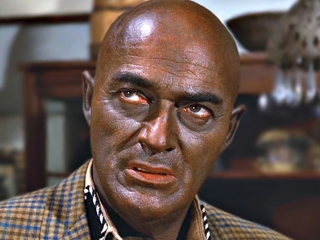
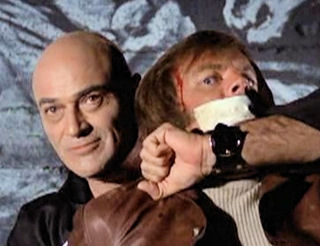 Above left: In the Mission Impossible episode "Kitara" (CBS, Feb 20. 1971) as Colonel Alex Kohler. Above right: Dobkin as mass murderer Gregory Praxas in a 1972 pilot film for Streets of San Francisco holds David J. Farr (Robert Wagner). 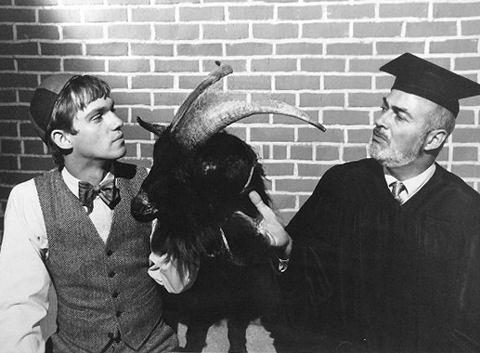
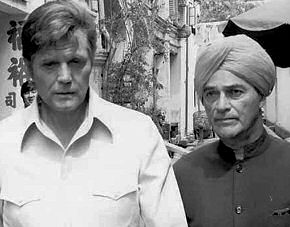 Above left: Richard Thomas (L), as John-Boy Walton, finds his first day at college is a series of disasters when he is duped into taking a goat to Prof. Ghote, the chairman of the English department (Lawrence Dobkin), in "The First Day" (The Waltons, CBS, Sep 19. 1974) Above right: When Five-O Chief Steve McGarrett (series star Jack Lord) travels to Singapore to break up an international drug ring, he meets a General Oban (Lawrence Dobkin), in a special two-hour episode of Hawaii Five-O (CBS, Apr 5. 1979). |
|
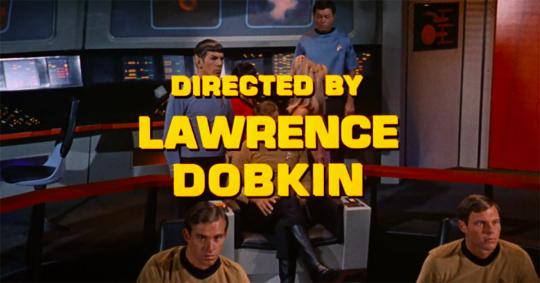
Dobkin wrote for Tarzan (NBC, Mar 24. 1967, min. 1), The Life and Time of Grizzly Adams (film in 1974 and 2 episodes in 1977), a highly-successful TV series The Rifleman (ABC, Jan 24. 1961 - May 7. 1962, min.2) and others. He and another actor, Andrew Robinson, have the distinction of being the only ones to have both acted in and directed episodes of Star Trek. Directing Star Trek ("Charlie X" NBC, Sep 15. 1966) and playing Klingon Ambassador Kell in Star Trek: The Next Generation (Paramount TV, May 25. 1991). As to his many other TV directing duties, to name a
few: After Fame (NBC, Nov 30. 1985) Dobkin retired from directing in 1985, but continued acting until his death. |
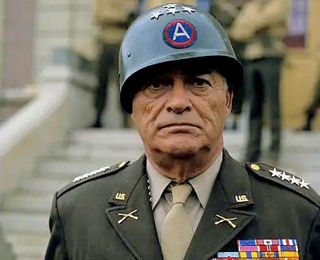
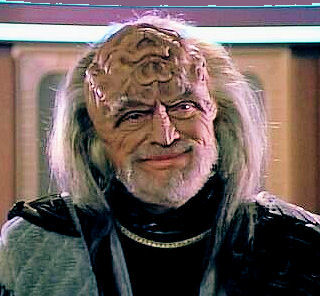 Above left: As General Patton in the mini-series War & Rememberance (ABC, 1989). Above right: Dobkin as Klingon Ambassador Kell in Star Trek: The Next Generation. "The Mind's Eye" (Paramount TV, May 25. 1991). |
|
As voice actor Dobkin contributed to the video game Tom Clancy's Rainbow Six: Rogue Spear (1999). Larry died of heart failure on October 28. 2002, in Los Angeles. His body was cremated and his ashes scattered at sea. "The few of us who are left,..." Dobkin said of his radio days not long before he died, "...keep telling each other that we never had it so good." |
 |
|
Notes: * There is to our knowledge no episode of Ellery Queen which had Phil Harris and Alice Faye as armchair detectives. ** Watch on the Rhine (Martin Beck Theatre, Apr 1. 1941 - Feb 21. 1942). *** Many of the Escape stories also became radio classics, later repeated on its well-to-do sister series, Suspense. Suspense was everything Escape was not: it had sponsors, fame, tradition, and timeslots that were consistent, at least for seasons at a time. But Escape held its own. Suspense concentrated largely on mystery and crime: on Escape, if mystery was used, it was often an exclamation point to the life-or death situation that accompanied it. Escape used more stories of the supernatural, of man against the jungle, of war and the Old West. (The Encyclopedia of Old-Time Radio, John Dunning) All dates for movies are for the first US release. All dates for TV programs are original first airdates. All dates for (radio) plays are for the time span the actor was involved. Facts in red still need confirmation. |
Click on Uncle Sam if you think you can help out...!
 |
|
Other references (1) Wikipedia (2) May 26. 2007 Old Time Radio column by the late Betsy W (Betsy Weinberg) (3) Radio of Yesteryear Biography (4) IMDb (5) Radio Spirits (6) OTRRpedia (7) Radiogoldindex (8) Interview Charles Dennis, 2009. See below (7) (9) Dobkin in The Sound of Detection, 2002 Additional video & audio sources (1) The Killer "The Man with the Camera" (1959) (2) The DuPont Show with June Allyson: So Dim The Light (1960) (3) Sweet Smell of Success (1957) (4) Dream Away Commercial (1987) (5) Lawrence Dobkin on Auditioning for Jack Webb Wallbreakers Soundcloud, audioclip (6) Trackdown (1958) Episode of the TV series with Larry as "Trump" who comes to town and warns people the world will be destroyed, only to be saved if they build a wall. (7) Paid to Dream presented by Foo Dog Films Charles Dennis (8) Fighting AAF Farewell broadcast (Corporal Larry Dobkin) Nov 8. 1945 |
|
This actor profile is a part of
Ellery Queen a website on deduction.
The actor above played Ellery Queen in
an Ellery Queen radio series.
Click Uncle Sam if you think you can help
out...! Many of the profiles on this site have been compiled after very careful research of various sources. Please quote and cite ethically! |
|
Page first published on March 10. 2013 Versie x2.2 - Last updated July 23. 2026 |
b a c k
t o L i s t o f S u s p
e c t s
|
|
Introduction | Floor Plan | Q.B.I. |
List of Suspects | Whodunit? | Q.E.D. | Kill as directed | New | Copyright  Copyright © MCMXCIX-MMXXVI Ellery Queen, a website on deduction. All rights reserved. |